What counts as wheelchair accessible
Plenty of units are sold as "accessible" that a wheelchair user cannot actually use. Strip the labels away and five things do the work:
- Level or ramped entry. A chair has to roll in. A step or a raised lip at the threshold rules the unit out on its own.
- A wide door. Around 810mm of clear width or more. A standard portable toilet door is far narrower than a wheelchair.
- Internal space to transfer. Enough room to bring the chair alongside the WC and transfer across. Our self-contained unit is 1.6m by 1.6m inside.
- Grab rails. Interior handrails positioned for the transfer to the seat, not bolted on wherever there was wall.
- Low-level basin and flush. Controls a seated user can reach. Our portable unit flushes with a hand lever beside the seat rather than the floor-mounted hand pump most suppliers fit.
If a unit fails any one of these, it is accessible in name only. Check the five points against the spec sheet before you buy, whoever you buy from.
The rules: Document M, the Equality Act and HSE
This is where most of the confusion lives, so here it is precisely.
Inside buildings: Building Regulations Approved Document M
Approved Document M of the Building Regulations sets the standard for toilets inside buildings. For a wheelchair-accessible WC it expects a room of at least 1500mm by 2200mm, an outward-opening door giving around 850mm clear width, a corner WC with grab rails in set positions, a low basin the user can reach from the WC, and an emergency alarm cord reaching to floor level. If you are fitting out a building, that is the layout building control will look for.
Portable and standalone units: the Equality Act and HSE
Document M applies to buildings, so portable and standalone toilet units are not covered by it. No portable unit meets Doc M, whatever a sales page claims, because Doc M simply does not apply to it. Be wary of any supplier selling a portable unit as "Doc M compliant"; the claim has no basis.
What governs portable provision instead:
- The Equality Act 2010. Anywhere the public is served, you have a duty to make reasonable adjustments for disabled people. An accessible toilet alongside the standard units is the usual, straightforward answer for events, campsites, sports grounds and attractions.
- HSE welfare rules. On workplaces and construction sites, welfare provision has to be suitable for everyone on site, which means accessible provision where the workforce or site rules call for it.
Buying options and prices
Four ways to own accessible provision outright, all brand new, all ex VAT and ex-works with delivery quoted by postcode:
| Unit | What it is | Price ex VAT |
|---|---|---|
| Wheelchair-Accessible Portable Toilet | Self-contained, roll-in level floor, 810mm door, interior handrails, handle flush. No connections needed. In stock. | £2,199 |
| Accessible Mains Toilet Unit | Access ramp, ceramic flushing WC and basin, connects to mains water, drain and power. | £2,999 |
| 10ft Accessible Toilet & Shower | Insulated plumbed steel cabin with accessible WC, basin and shower in one room. Made to order. | £11,500 |
| 10ft Accessible WC Cabin | Plumbed steel cabin with WC and basin, mains water and drainage connections. | £13,400 |
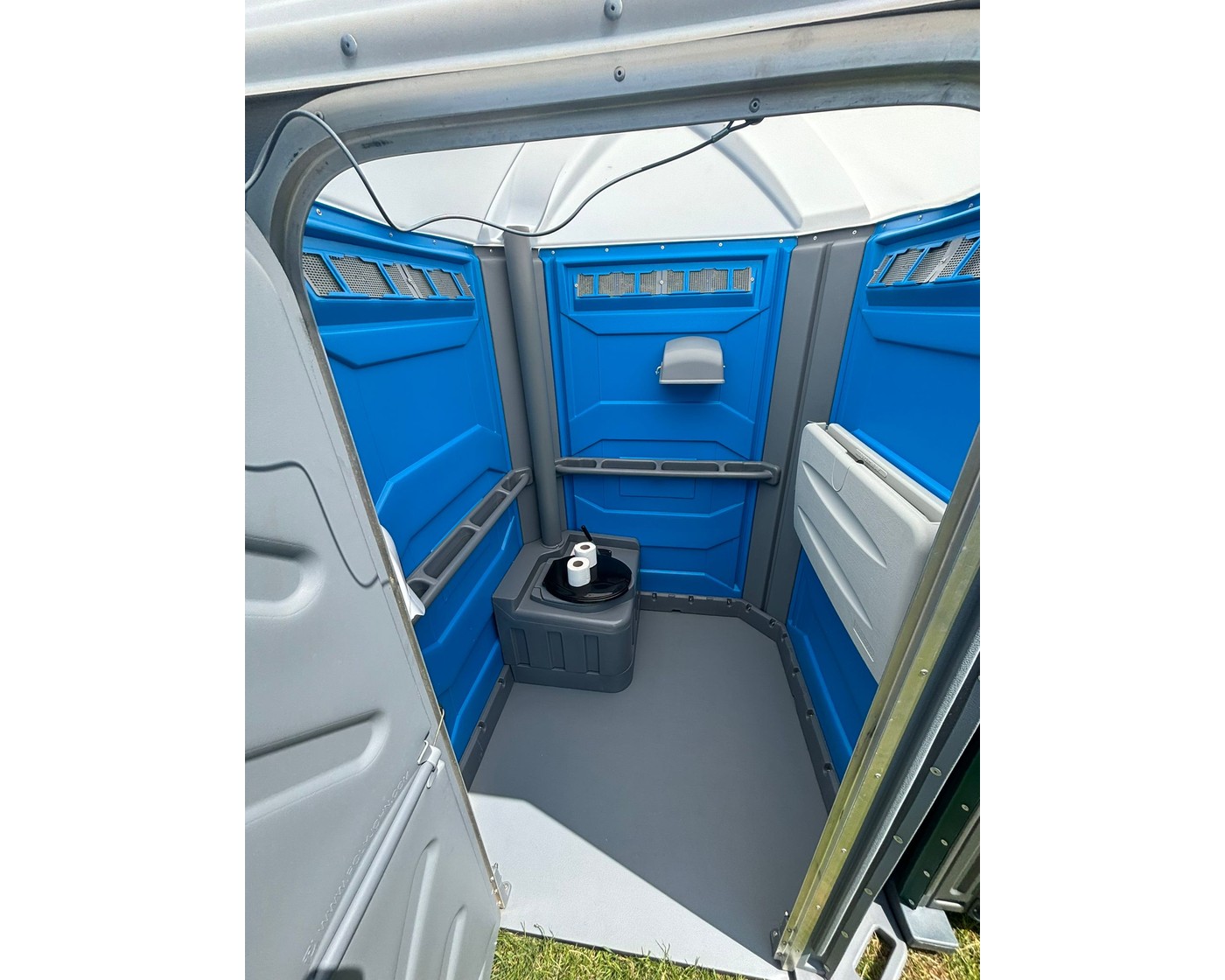
The self-contained portable at £2,199 is held in stock and arrives fully assembled, usually within days, where most accessible units on the market are made to order on lead times of around 12 weeks. Extras fitted before delivery: a fold-down baby-change table at £435 ex VAT and an internal hand-wash sink at £275 ex VAT. Full detail, photos and specs are on the accessible toilets for sale page, and sales run under our portable toilet terms.
Which one to choose
- Event or short-term site, no services: the self-contained portable at £2,199. The flush recirculates from its own sealed tank, so stand it on firm, level ground and it works. Any local sanitation contractor empties and recharges it on the same round as hire units.
- Permanent position with mains services: the ramped mains unit at £2,999. Ceramic flushing WC and basin plumbed to mains water and drainage, so it works like a permanent washroom and never needs emptying.
- Building-grade permanent provision: the plumbed steel cabins. The 10ft accessible WC cabin at £13,400 gives a full-size accessible washroom; the 10ft toilet and shower cabin at £11,500 adds showering for campsites, sports grounds and accommodation sites, insulated for year-round use.
How many accessible toilets do you need?
For most sites the answer is one accessible unit alongside the standard provision, positioned where the route to it is step-free. Larger events scale up roughly one accessible unit per ten standard units. The overall numbers for crew or crowd are covered in our how many toilets do I need guide.